
How World Cup AI Reshaped the 2026 Tournament
World Cup AI played a major role in how the 2026 FIFA World Cup was analysed, officiated and presented to supporters. Artificial intelligence did not replace coaches or…
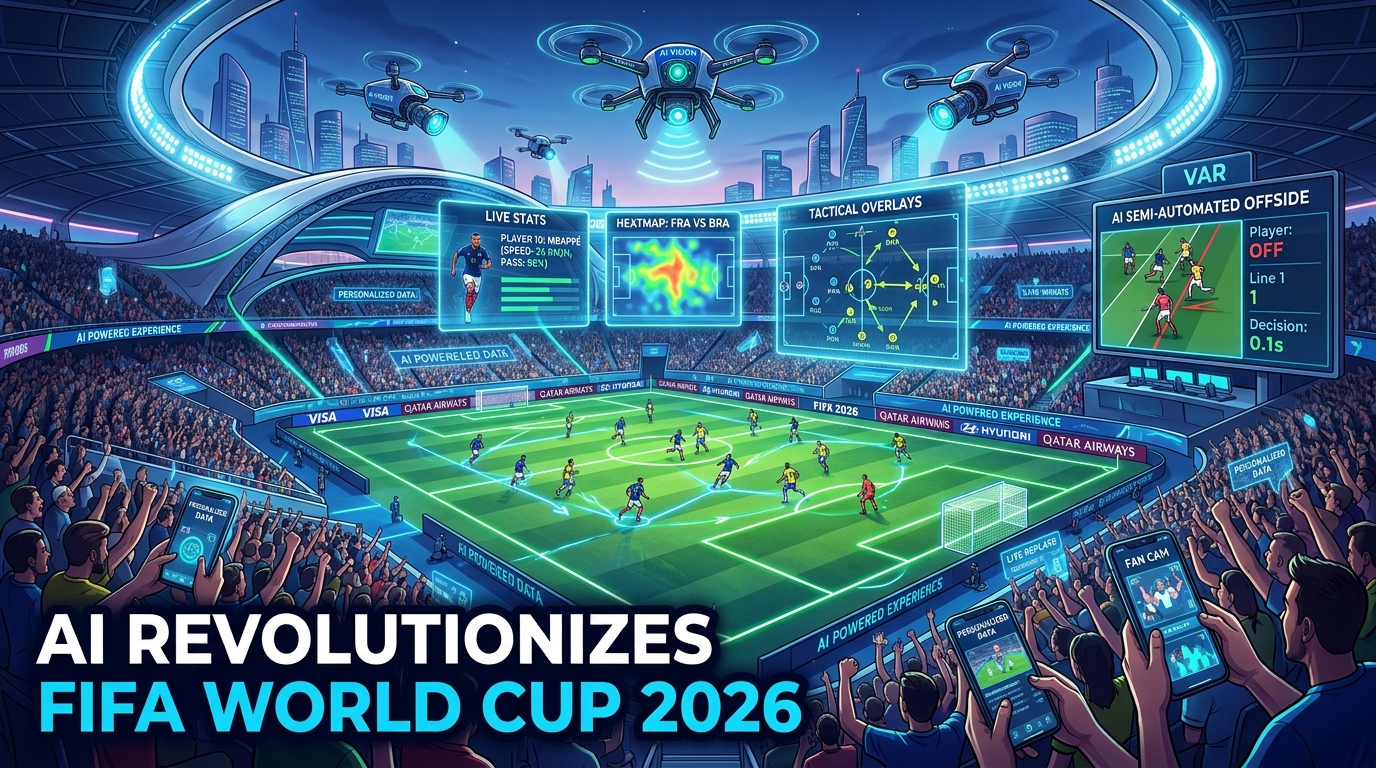
World Cup AI played a major role in how the 2026 FIFA World Cup was analysed, officiated and presented to supporters. Artificial intelligence did not replace coaches or referees, but it gave them faster access to information and improved several technologies operating behind the scenes.
FIFA and its official technology partner Lenovo introduced AI-supported tools for all 48 participating teams, match officials and broadcasters. These systems influenced tactical preparation, offside decisions, 3D replays and the way fans experienced matches.
1. World Cup AI Gave Every Team Advanced Analysis
One of the tournament’s most important innovations was Football AI Pro. FIFA described it as a generative AI assistant designed to provide pre-match and post-match analysis to all 48 competing teams.
The system analysed hundreds of millions of FIFA-owned football data points. It could then present information through written explanations, videos, graphs and 3D visualisations.
This meant smaller national teams could access many of the same analytical capabilities as wealthier federations. Teams with limited analysis departments could search for specific tactical information instead of manually reviewing lengthy reports. For additional football updates and sports resources, visit Velki.
2. World Cup AI Made Tactical Preparation Faster
Before the introduction of Football AI Pro, teams often received detailed match reports that could reach 50 or 60 pages. Analysts then had to examine those documents and identify the information most relevant to the coaching staff.
World Cup AI made that process faster by allowing analysts to ask direct questions. A team could investigate an opponent’s pressing structure, passing patterns, defensive positioning or set-piece behaviour.
The technology did not automatically create a winning strategy. Coaches still had to judge whether the information was accurate, relevant and suitable for their players.
However, faster access to reliable match data gave teams more time to focus on training and communication.
3. AI Supported Faster Offside Decisions
Advanced semi-automated offside technology was used at a FIFA World Cup for the first time in 2026. The system combined optical tracking, ball information and digital player models to support match officials.
Clear positional offsides could be communicated more quickly to officials on the field. More complicated situations, such as whether an offside player interfered with an opponent, still required human review.
World Cup AI therefore assisted referees rather than replacing them. The final responsibility remained with the match officials and the video assistant referee team.
4. Player Avatars Improved Offside Visualisations
Every participating player was digitally scanned to create a detailed 3D avatar. FIFA said each scan took approximately one second and captured accurate body-part measurements.
These player models helped the tracking system identify athletes during fast movement or when parts of their bodies were obstructed from camera view.
The avatars also improved the offside animations shown to fans. Instead of displaying generic figures, broadcasters could present recreations that more closely resembled the players involved in the decision.
This use of World Cup AI made technical decisions easier for viewers to understand. It also created a more realistic presentation for stadium screens and television broadcasts.
5. World Cup AI Improved Referee Camera Footage
Referee body cameras gave audiences a first-person view of selected moments from the pitch. However, rapid movement could create unstable footage and motion blur.
AI-powered stabilisation software was used to produce smoother images from the referee’s camera. This improved the quality of the footage available to broadcasters and gave supporters a clearer view of the speed and pressure experienced by match officials.
The technology also increased transparency. Fans could better understand what the referee could see during crowded or fast-moving situations.
The official FIFA overview of its 2026 technology explains how referee cameras and other systems were developed for the tournament.
6. Tracking Data Created Detailed 3D Matches
Sixteen optical tracking cameras were installed in each of the tournament’s 16 stadiums. According to FIFA, the system produced more than 150 million tracking data points during each match.
This information allowed the entire game to be recreated in three dimensions. The 3D feed could help VAR officials examine whether an offside player blocked a goalkeeper’s view or interfered with play.
Media organisations could also use the information to produce tactical graphics, replays and visual explanations. World Cup AI helped transform raw tracking information into content that analysts and fans could understand.
7. AI Changed the Fan Experience
The influence of artificial intelligence extended beyond coaches and referees. AI-supported graphics, player avatars, stabilised camera footage and detailed data presentations changed how viewers followed matches.
Supporters received more visual explanations of close decisions. Broadcasters gained additional material for tactical discussions, while digital platforms could present match information in more engaging formats.
Did World Cup AI Make Football Fairer?
World Cup AI helped reduce one type of inequality by giving every participating nation access to the same Football AI Pro platform. This was especially valuable for teams that could not afford large groups of analysts.
However, equal access to software did not remove every competitive difference. Wealthier football nations still had stronger development systems, larger coaching teams and greater experience using performance data.
AI could provide information, but teams still needed qualified people to interpret it. Technology made analysis more accessible, not automatically more effective.
The Risks of Using AI in Football
Artificial intelligence can produce misleading conclusions when data is incomplete or interpreted without context. Football is also unpredictable, and not every tactical decision can be reduced to statistics.
Privacy is another concern because tracking systems collect detailed information about player movement and physical performance. FIFA and national teams must manage that information responsibly.
Transparency is equally important. Fans should understand when AI supports a decision and when a human official makes the final judgement.
Conclusion
World Cup AI influenced the 2026 FIFA World Cup by improving match analysis, offside technology, player tracking, broadcasting and fan engagement. It gave teams faster access to tactical information while helping officials make certain decisions more efficiently.
The tournament demonstrated that artificial intelligence can support football without taking control away from people. Coaches still designed the tactics, players determined the results and referees remained responsible for decisions.
The lasting impact of World Cup AI will depend on whether similar tools become affordable and accessible across women’s football, youth development and smaller competitions.
FAQs
What was Football AI Pro?
Football AI Pro was a generative AI assistant that provided pre-match and post-match analytical information to all 48 teams at the 2026 FIFA World Cup.
Did AI make referee decisions at the World Cup?
No. AI-supported systems helped identify situations and provide information, but human match officials remained responsible for final decisions.
How did AI help football fans?
AI improved offside animations, referee-camera footage, 3D replays and tactical graphics shown during broadcasts.
Did every team receive access to World Cup AI?
All 48 participating teams received access to Football AI Pro and its advanced analytical capabilities.
সম্পর্কিত আর্টিকেল

The Science Behind Football Player Recovery: How Elite Athletes Stay Match Ready
Football Player Recovery is one of the most important aspects of modern football. Professional players cover more than…
আর্টিকেল পড়ুন
Golden Boot vs Golden Ball: World Cup Awards Explained
Golden Boot and Golden Ball are two of the most important individual awards presented at the FIFA World…
আর্টিকেল পড়ুন
Paraguay Eliminate Germany in One of the Biggest World Cup Shocks
Paraguay vs Germany delivered one of the greatest surprises of the FIFA World Cup 2026 as Paraguay eliminated…
আর্টিকেল পড়ুনসব ব্লগ দেখুন
টিপস, গাইড, স্ট্র্যাটেজি — পেশাদার প্লেয়ারদের লেখা আরও আর্টিকেল।